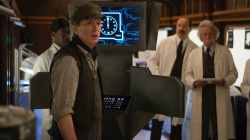
Oh no. Not her. Please don’t pass her over to me Dad. Martha winced as the grating sound of Annalise’s voice filled her ear. ‘Hi Martha! Hii-iii!’
Martha moved the earpiece slightly away, and put on her best fake telephone smile. ‘Hi Annalise.’
‘Big kisses! Lots of love! See you at the party babes!’ chirped Annalise in reply. Martha heard the sound of engines revving, followed by ‘Now take me shopping, big boy.’ followed by the unmistakeable sound of a big sloppy kiss.
Martha shuddered, and held the phone even further away this time, in the hope that the call would disconnect itself, and kept moving. Suddenly, a man was stood right in front of her. He was tall and as thin as a drainpipe, dressed without a care for the weather in a pin-striped brown suit and grubby plimsolls, topped with a beige trenchcoat. His brown hair fanned out like a peacock’s feathers, and he had a slightly crazed look in his eyes.
‘Like so!’, announced the man, who broke into a broad, toothy smile as he removed his tie, holding it up in one hand as though he had just caught a fish. ‘D’you see?’, said the strange man. He then ran off before Martha had the chance to reply, disappearing into the bustle of commuters as suddenly as he had arrived.
Martha shrugged it off and kept moving. He was quite nice looking, she thought, but quite possibly disturbed. Her phone rang again. Without even looking, she declined the call and slid the phone back into her bag, and cheerily continued her walk to work. It was a gloriously sunny spring day, so Martha didn’t notice the incongruous black storm clouds gathering at the end of the road behind her, and wouldn’t have thought to look for them. The clouds flashed with angry blue streaks of lightning. It was not going to be an ordinary day.
(Adapted from Smith and Jones, by Russell T. Davies, extract novelised by Martin Ruddock)
I wish the above was real. But, it’s not. There are no novelisations of TV Doctor Who stories anymore.
By and large, they’re a thing of the past. Once upon a time, novelisations were the great constant of being a Doctor Who fan. Unlike TV episodes in the pre-VHS era, you couldn’t miss a novelisation. It was only a matter of time before the one you were missing cropped up in a bookshop near you. Few TV episodes from before 1989 have yet to make it to paperback form. Unfortunately, when Doctor Who returned in 2005, novelisations were one aspect that failed to make the transition.
This is a shame, of course times have moved on, and the series is bigger and harder to miss than ever. Even if you don’t have the DVDs, or Netflix, repeats of Who are on constant rotation these days. I still can’t help feeling, however that a generation or two of children have missed out. Kids should be able to walk into shops and beg Mum and Dad for pocket money for Doctor Who and the Vampires of Venice, or Doctor Who and the Shakespeare Code. That said, how to approach novelising something uniquely structured like Midnight, or timey-wimey like The Wedding of River Song would be a head-scratcher.
The original Target novels of the 1970s through early 90s were a triumph in many ways. A gateway drug to literacy for children, a window to the past to missing episodes or existing stories that were transmitted once and then not repeated, mini blockbusters that eliminated budgetary limitations and set the controls straight for your imagination. The only limit was that of page count, and in this reader’s case, how many pages you could cram in before lights-out, or before car sickness kicked in.
The earliest entries in the series famously expanded on what you saw on TV; particularly those penned by Malcolm Hulke. Hulke was already known for the moral shades of grey in his tales, but he flourished even more in print; giving Silurians names, a giant maggot its own point of view chapter, fleshing out the motivations of Doctor Quinn and IMC employees, and killing off an unfortunate Scottish football supporter at the claws of a dinosaur in a prologue straight out of a horror novel. Unfortunately Hulke was unwell at the time he novelised The War Games, his only slightly lacklustre effort. In addition, by that point Target’s efforts were averaging a lean 120 pages, so he was unable to expand on The War Games, which was published posthumously two months after his death in 1979.
Then of course, there is Terrance Dicks. The stories adapted by Dicks are barnstorming overhauls of the originals. The text is deceptively simple and unfussy, and he makes it look effortless, but the images leap off the page, and take root in your imagination. He also takes the opportunity to rationalise dialogue and plot holes (For a randomly picked example, watch The Claws of Axos episode one, then read the first two chapters of the novelisation, and see how an extremely grumpy Doctor is given a major charm injection).
Also, he gets you right from the opening line. “Through the ruin of a city stalked the ruin of a man”….. “Kriz was dying. Painfully he dragged his insect-like body away from the blazing ruins of the shattered spaceship.”… “High on the himalayan mountainside the little camp fire was burning low…” to name a few.
Ian Marter’s tough adaptations of Hartnell, Troughton and Tom Baker stories push the envelope by being more violent than usual, and occasionally contain somewhat more forthright language than would be allowed now. The only way in which his version of The Dominators doesn’t wipe the floor with the TV version is that we are missing the performances of Troughton, Fraser Hines, and Wendy Padbury. Unfortunately, Marter died young in 1986 at the age of only 42, his final two novelisations were released posthumously.
Robert Holmes did just the one book for Target after years of persuasion, but his delightfully gruesome take on The Two Doctors is a treat.
Later novelisations of McCoy stories by Ben Aaronovitch, Marc Platt, and Ian Briggs are more sophisticated, like director’s cut versions of their TV counterparts, which help make sense of ideas occasionally slightly lost in translation through editing. Remembrance of the Daleks, re-released by BBC books last summer, is particularly of note, and one of the best novelisations ever. Already beautifully formed on TV, Aaronovitch takes the opportunity to sketch in more background detail about Ace’s past, Davros and the Special Weapons Dalek are given vivid origin stories, there’s even a little cameo for ‘the other’.
The novelisation is not completely dead. More recently, Gareth Roberts has given us the most fully formed version of Shada we could have hoped for, his take on City of Death is out next year. This leaves only The Pirate Planet, Resurrection of the Daleks, and Revelation of the Daleks outstanding from the original series. Hopefully, the estates of Douglas Adams and Terry Nation and writer Eric Saward would agree to finally allow us to complete our set.
Except, it’s not a complete set, even if we were to put these hypothetical novelisations on the same shelf as our much-loved, (mostly) out of print Target novels. There is a glaring and growing gap. Of course, the original authors (especially RTD and Steven Moffat) are too busy to adapt their work into print, non-showrunning writers such as the excellent Gareth Roberts are probably too busy as well. But, maybe for the tenth anniversary of the revived series, we could have a little treat, and sit down to read Doctor Who and Rose? Perhaps Terrance Dicks could give us one last gift to read, and pass on to our own children.
Martha moved all around the Police Box, looking for the trap door or false wall she was expecting, that would explain this impossible box, before looking back through the doors. Her neck creaked as she spun her head around, trying to fit what she was seeing into her eyes.
‘But it’s just a box… But it’s huge! How does it do that? It’s made of wood! It’s like a box with that room just…. crammed in!’
The Doctor was leaning on a rail halfway up the ramp. He nodded and rolled his eyes. He had been through this before, more times than he could count. He wondered for a second if he had made it worse for himself since he changed the TARDIS’s desktop theme.
Martha walked up the ramp to face the Doctor. ‘It’s bigger on the inside!’ ‘Is it? I hadn’t noticed’, said the Doctor, casually. He ran to the TARDIS console, and began punching at buttons and throwing levers, seemingly in random order. Martha composed herself. ‘Is there a crew? Like, the navigator and stuff, where’s everyone else?’
The Doctor looked up. ‘It’s just me.’ Martha looked at him teasingly. ‘All on your own?’
The Doctor shuffled uncomfortably from one foot to the next. ‘Well, sometimes I have… guests. I mean, sort of friends, travelling alongside me. I had….’ He paused for a second, before continuing. ‘There was, um…..recently….a friend of mine. Rose, her name was Rose, and, um.. We were together, and… anyway….’
‘Where is she now?’, asked Martha. ‘With her family.’ the Doctor replied. ‘Happy! She’s fine, she’s… Not that you’re replacing her!’ ‘Never said I was’, smiled Martha. She was enjoying watching him flinch.
‘Just one trip’, continued the Doctor. ‘To say thanks, yes, you get one trip, then back home, I’d rather be on my own.’ Martha smiled again. ‘You’re the one who kissed me’. ‘That was a genetic transfer!’, protested the Doctor. ‘And if you will wear a tight suit….’ said Martha. The Doctor looked ruffled. ‘Now, don’t.’
Martha continued: ‘And then travel all the way across the universe to ask me on a date….’
‘Stop it!’, snapped the Doctor. He was really fidgeting now, as if he’d used up his allotted time in one place, and was itching to get away.
Martha shrugged. ‘For the record, I’m not remotely interested. I only go for Humans.’ The Doctor looked relieved. ‘Good! Now then, let’s have a look…..’
He ran around the console flicking switches, lost in his own cleverness. He didn’t notice the flash of disappointment that crossed Martha’s face. ‘….close down the Gravitic Anomalyser. Fire up the Helmic Regulator. And finally… the handbrake!’ He looked at Martha. ‘Ready?’ ‘No!’ replied Martha.
The Doctor grinned and pulled a lever, bringing it down with some force. ‘And off we go!’
The room began to shake, and Martha grabbed on to the console and clung on. A loud, wheezing, groaning sound, deafening but somehow beautiful filled her ears as the huge central column rose and fell. ‘Blimey! It’s a bit bumpy!’ shouted Martha.
The Doctor reached across the console and offered his hand with a smile ‘Welcome aboard, Miss Jones.’ Martha reached for his hand and shook it. ‘My pleasure, Mr Smith.’ He smiled a wide, boyish smile, and continued to flick switches and levers as the TARDIS bucked like an unruly mule. It was almost as if it was alive, thought Martha, as she clung on. This had definitely not been an ordinary day.
The TARDIS spun through the time vortex, speeding them towards new adventures.
(Adapted from Smith and Jones, by Russell T. Davies, extract novelised by Martin Ruddock)
Extracts from Doctor Who and the Brain of Morbius, Doctor Who and the Dalek Invasion of Earth, and Doctor Who and The Abominable Snowmen are copyright Terrance Dicks.


Latest News