An encyclopaedic knowledge of Doctor Who can be a dangerous weapon in the hands of a scriptwriter who simply loves to tease and misdirect his show’s fan base with such delicious cunning. During the build up to the Series Eight finale, we were promised that the identity of the mysterious Gatekeeper of the Nethersphere, Missy, would be revealed in the first part. And this time with surprising directness, Moffat didn’t lie. But as is his want, the showrunner carried the revelation off not without a little bit of teasing along the way.
Some of the prime candidates for Missy’s identity, at least in the minds of enthusiastic fans, were all variously called to mind through key lines and moments - the computer interface (e.g. Hal), the Rani (a Time Lady last seen abandoned by the Doctor to the Tetraps, Time And The Rani) Romana (affectionately known as Mistress by K9), River Song (in what looks suspiciously like The Time Traveller’s Wife book holding the TARDIS key, and the kiss) the Great Intelligence (the use of the iPad to manipulate/delete emotions – The Bells Of St John) and even Clara herself (whose grief could be mistaken for a cold detachment and who betrays the Doctor) ensured that the Master reveal remained a surprise. They were clearly deliberate rouses, ones subtle enough to make the episode still work for the uninitiated.
During the Russell T. Davies era and continued into Steven Moffat’s first series at the helm, the use of the two parter for the season finale seemed to come with the unwritten rule that each time the stakes should be raised, leading to the most ridiculous of cliffhangers. The Master’s last appearance came with such an outlandish moment with the whole of the human race transformed into his physical likeness. It was a welcome and liberating decision to move to single episode finales. However, sometimes this approach had the flip side of causing confusion through a lack of exposition.
Thankfully Dark Water, eschewing the pattern of escalating threat, finishes on a sombre note with Danny’s finger hovering over the delete button. Instead of spending a week contemplating how the situation will be resolved, we are left to ponder the tragedy of Danny Pink’s plight and the impossible choices he faces in shutting down contact with Clara and in unwittingly allowing himself to be converted into a Cyberman. Last week the idea that it might be good to forget, was celebrated by the Doctor, but here we see that life without pain and suffering is dehumanising. Danny’s guilt at the death of the young civilian shaped him into the good man he had become by the time Clara Oswald first met him.
The chemistry between Jenna Coleman and Peter Capaldi is once again electric, and in Dark Water they are rewarded with plenty of emotionally charged dialogue from which to work their magic. As the season has progressed, we have gradually shifted our allegiance from Clara to the Doctor, but here, after their battle for control in the dream sequence, the two leads finally come together as a partnership of equal merit. When the Doctor smiles as Clara cries in anguish having thrown away the last of the seven TARDIS keys, he is not gloating, even though he was about to prove to her that he was still in ultimate control. Rather, the Doctor is feeling joyous that he has broken through to whatever has been eating away at Clara. By manipulating her into a situation where she can cry the tears her Gran had unsuccessfully encouraged her to shed, the Doctor achieves a breakthrough. It’s taken eleven episodes and the tragedy of Danny Pink’s death, but finally the two can act as one. Echoing his seventh incarnation, the Doctor rallies his forlorn and grieving companion with a battle cry “…we’ve got work to do. The darkest day, the blackest hour - Chin up, shoulders back, let’s see what we’re made of, you and me.” Touchingly the Twelfth Doctor finally concedes his unconditional care for Clara “Did you think that I would care for you so little, that betraying me would make a difference?”
Given Steven Moffat’s trademark fiendishly timey-wimey plots, this tale is a straightforward, linear one. We are pulled into the story not out of intrigue with the complex plot but from our emotional engagement with the characters. Both Coleman and Anderson display moments of raw emotion so very rarely seen in Doctor Who, with the ability to act through their tears. The nearest equivalent story would be Fathers Day, but the impact of loss is less realistically and harshly put in Cornell’s Series One script. Clara having lived a thousand lives to save the Doctor certainly has good cause to feel that she is owed this one thing. Her request leads to another one of those periodic discussions about why time cannot be altered and paradoxically, under which circumstances it can be. At first it seems that the Doctor is fobbing Clara off by arguing that only with precision and great care can time be rewritten, but he goes on to concede that it is an instinctive knowing of when he can and when he cannot interfere. There is always something new to add to the central paradox of the show.
Dream sequences are notoriously hard to pull off and usually avoided by writers, but it is testament to Moffat’s brilliance that he can make this work. It is stunningly realised and explains why the Doctor and Clara did not remember the nifty click of a finger trick by which the TARDIS doors will open without a key. Clara is punishing the Doctor by threatening to take away his most precious of possessions, not the TARDIS per se, but the freedom that travelling in her affords.
He honours his friendship with Clara by finding a way of reaching out to Danny beyond the grave, but warns her that what they discover may be deeply unpleasant.
When it comes to knowing what exactly the Doctor believes in, the series has always kept us guessing. Even when Amy Pond finally asked in The God Complex “what do Time Lords pray to?” the answer is evasive. The Doctor journeys through his long life expressing different stages of faith, from the optimist to the skeptic. The Twelfth Doctor is very much in the latter camp, believing that any life after death must be a kind of hell. He honours his friendship with Clara by finding a way of reaching out to Danny beyond the grave, but warns her that what they discover may be deeply unpleasant. But just as in The Impossible Planet and The Satan Pit the Doctor seeks to find a truth behind the myth of the Satan figure, here he shows a very real desire to search for a truth behind the belief in the afterlife “Always meant to have a look around to see if I could find one.” The flippancy of his words suggests the quest is not a spiritual one but to simply satisfy his curiosity.
Though aware of Clara’s emotional state, the Doctor interprets it scientifically as “a mass of chemicals.” There is no room for sentiment “let it hurt, let it burn, but don’t bleat, don’t ask why him, why me. Ask one question where is Danny Pink” This feeling that emotions get in the way, marks a departure from the recent emphasis on emotions triumphing over the cold face of evil, especially the emotionless Cybermen (Closing Time). And yet the Doctor is not completely heartless and appears to be fighting any inclination to feel empathy for Clara, rebuking her for her puppy dog eyes.
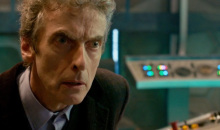
The Doctor’s immediate assumption is that he and Clara are being duped and herein lies his very differently motivated yet equally emotional engagement with the events. As we see in the wonderful close up when he shouts “fakery” he is angered by what he suspects are forces who are manipulating and deceiving others including Clara, who he encourages to be skeptical. This is even before the grim discovery of the Master and the Cybermen’s involvement.
Visually the images of the Cybermen breaking free of their tombs is a classic one told with a new twist.
The last time the Master worked with the Cybermen (The Five Doctors), the once scary foes had already become predictable and all too easy to defeat (as easy as pi in fact), loosing much of the fear factor in the process. Arguably before Dark Water we had to go back to the 60s for a good Cyberman story, certainly one in which they might send the children scuttling behind the sofa. Steven Moffat in his first Cyberman script, significantly raises the threat by coming up with an ingenious new approach, one that required the mind and technology of a Time Lord to execute. The use of the iPad delete button is chilling in its simplicity as the personal version of a red button that could set of a nuclear war. Visually the images of the Cybermen breaking free of their tombs is a classic one told with a new twist, the concept of the dark water substance really just an excuse for a great visual reveal.
For the astute fan, the Cybermen and the Master are signalled in advance by audio clues in Murray Gold’s remarkable score. Delightfully when the Doctor thinks aloud that he might be missing the obvious, the doors close to reveal Cybermen eye and tear duct shaped windows. The striking up of the theme from Rise of the Cyberman reinforces that connection just in case we missed it. But, more subtly as Missy strokes the “fish tanks” we hear traces of the Master’s theme from Last of the Time Lords.
Michelle Gomez is a revelation as Missy, with a noticeable shift in tone once her lie about being a computer hologram has been exposed. On second viewing it is clear that the Master wants the Doctor to uncover who she is, deliberately exaggerating the monotone computer voice of MISI. Her matrix construct Seb is in many ways more like John Simms’ Master than she is. Chris Addison’s character might perhaps be described as a representation of the master in the matrix.
Rachel Talalay’s direction is brimming with stand out moments and it is often in the littlest of touches that the biggest effects are created. The fire from the volcano reflected in TARDIS windows, the sight of the Fourth Doctor’s yo yo in the TARDIS drawer, the shot looking from the ground up at the two time lords as they leave the Mausoleum, the wide angle image of the Doctor hunched against the TARDIS console as he tells Clara “Go to hell” are just some of the incredibly evocative images. And we are even treated to a brief alien world when Doctor first accepts Clara’s call. The Caretaker had a similar opening and whilst it is logistically hard to set a whole story on a very alien environment, the odd scene can work a treat in reminding us that the Doctor travels through all of time and space.
It is hard to access the story as a whole until the denouement is aired next week, but Dark Water is a promising end to a remarkably strong series. Perhaps the changing of the Master’s gender is a trial run in accessing audience appreciation for a similar change to the main role. But given the wonderful performance of Gomez it is to be hoped that this is not a brief incarnation and that she becomes a semi-regular like Delgado and Ainley before her.
This was one of the darkest episodes in the fifty year history of the show, with some truly disturbing notions, the horrific thought that the dead can experience the pain of their own cremation perhaps the most unsavoury. But it is also dark in the uncompromising manner in which it highlights our fears of death and pain, our experiences of guilt and regret, and the sacrifices we sometimes have to make in those relationships that are the most precious to us. The original concept of the Cybermen as a humanoid race that once chose to be free of the shackles of emotions is back on the table. It replaces the more recent, less unpalatable idea of humans unwillingly being turned into Cybermen. The sobering fact is that every single one of us would more than likely follow Danny Pink in pressing the delete button. Sometimes we choose to be less than human.


Latest News