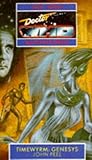
Mesopotamia - the cradle of civilization. In the fertile crescent of land on the banks of the rivers Tigris and Euphrates, mankind is turning from hunter-gatherer into farmer, and from farmer into city-dweller. Gilgamesh, the first hero-king, rules the city of Urak. An equally legendary figure arrives in a police telephone box: the TARDIS has brought the Doctor and his companion Ace to witness the first steps of mankind’s long progress to the stars. And from somewhere amid those distant points of light an evil sentience has tumbled. To her followers in the city of Kish she is known as Ishtar the goddess; to the Doctor’s forebears on ancient Gallifrey she was a mythical terror - the Timewyrm.
When Peter Darvill-Evans took over the Doctor Who range at Virgin Publishing following their acquisition of Target Books in 1989, he quickly realised that the number of available stories available for novelisation was quickly running out and approached the BBC for permission to publish original novels based on the series such as the Star Trek franchise had done successfully for many years. His initial approach was rejected but after the cancelation of the show in 1989, Virgin successfully acquired the license to produce what would for many years be seen as an unofficially official continuation of Doctor Who - The New Adventures.
Tagged as “to broad and too deep for the small screen,” the first in the series would be John Peel’s Timewyrm: Genesys, the first book in the linked Timewyrm saga. Peel had already contributed to the Target novels range and in a 2012 interview with Following the Nerd tells of how his commission to debut the new series came about:
“Well, I lobbied to be the first to write an original novel – I really wanted to be the first, so I pitched an idea as soon as I heard they were doing them. The editor, Peter Darvill-Evans, read it and then said: “Well, I wanted something with Sumerians in it. Do you know the Epic of Gilgamesh?” I’m a huge reader of ancient legends, so I did, in fact, and could turn around and pitch a Gilgamesh story almost immediately. Peter loved it, and gave me the go-ahead.”
With the remit of being more adult in tone, Timewyrm: Genesys wades directly into the deep end as following the prologue a naked Ace wakens aboard the TARDIS (“knickers! she thought triumphantly”) and from that point on it’s nubile teenagers, exposed breasts, sexual assault and borderline disturbing prose that seemingly delighted in all three of them. Much of the nudity and gory violence seem highly unnecessary despite the pretence to historic realism, more there to meet the desire of being “more adult” than actually being any use to the plot.
When it comes to actual characterisation and plotting, the novel is anything but adult in nature. One scene in particular stands out:
“That little slut, barely thirteen, barely marriable. And here she was, pretending to be a grown woman, putting herself on public display to have her body pawed by that egotistic lecher. The girl giggled as Gilgamesh slipped a hand down her front and tweaked.”
It is hard to believe the BBC would allow such a passage anywhere near any of their products in 2014 and certainly not Doctor Who.
Genesys has often come in for criticism for its characterisation of our leads - The Seventh Doctor and Ace. The Doctor of Timewyrm: Genesys is not the Doctor of Season 26, the darker “times champion” of the Cartmel Masterplan. Mixing his metaphors and acting with such flippancy, there is more Season 25 and Tom Baker in the character than there is late McCoy. Authour John Peel readily admits he was not a fan of the McCoy era:
“The main problem was that I was not a fan of the McCoy era. Both Sylvester and Sophie are truly the nicest of people, and we’ve always had great fun when we’ve met up at conventions (which is why Sophie agreed to write the intro for my novel), but I didn’t – and don’t – like their era. I thought they’d made a huge mistake with the concept of the “Time’s Champion”, and in having the Doctor instigate the stories by plotting against the Daleks and the Cybermen. One of the great strengths of DW has always been the possibility that the Doctor might fail. This adds tension to the stories. Okay, he’s the hero, so he isn’t going to fail horribly, but there’s always the chance. Especially Troughton, I think – you always feel he’s on the verge of really mucking everything up before he somehow saves the day! But McCoy’s Doctor, plotting and planning like it’s a chess match – that always struck me as being the wrong approach. So I was determined that in my story the Timewyrm was going to be the Doctor’s greatest mistake – hubris, pride taking its fall. In “Genesys”, the master-plotter fails, and it leads to catastrophe.”
The characterisation of the Doctor and tone of the New Adventures would go on to be one of the major schisms within fandom during the 1990s. Peel was certainly on the side of the traditionalists, despite the “adult” content of of his first New Adventure, as he said in 1996:
“If you’re writing a novel based on a TV show (whatever show), you should always try to conform to the show. Innovation is a major mistake, because you’re dealing with a shared universe. At the same time, you should be original and entertaining. The novels are there to compliment the TV series, not to change it. And if there isn’t any show… well, we should be continuing it, not altering it.”
Ace meanwhile has regressed from the developed character we saw at the end of Survival, also harking back to the earlier version of the character we saw prior to Season 26 after initially joining the Doctor in Dragonfire. There is none of the adult maturity that came about through her experiences in The Curse of Fenric, Ghost Light and Survival and Peel puts this down lack of communication with production staff during the writing of the novel:
“Ace… I had a lot of trouble with Ace. I couldn’t get a grip on her character. Why was she the way she is? What led her to be such a fiend with explosives? Were her parents alive? I sent in questions to the production staff, and they were absolutely no help at all. They did tell me, for example, that she’d lost her virginity to Glitz – which I didn’t care about – but nothing at all about her background! Which is why I invented a lot of it, I had no other choice. And since I wasn’t a fan of the JNT years, I got a few of my recollections wrong, and made some mistakes in continuity that were quickly commented on”
The supporting cast fair little better with Gilgamesh reduced to little more than a violent and boorish yob in the space of a few chapters, depute a promising introduction to the novel and while Ishtar has flashes of potential, eventually comes across as one dimensional and somewhat cliched into being an atypical Doctor Who villain. This one dimensional nature spreads from the characterisation and into the setting as although the book is full of detail and facts on the Mesoptamia of the time, the scene never feels truly like a living, breathing world.
The plot itself is simple and all in all, an easy read despite the gratuitous use of continuity references that would become something of a staple for the range. While the references may serve to link the series to the television experience, they also all too often detract from producing a unique and standalone product able to be enjoyed by novices and die-hards alike.
Perhaps final word however should fall to Gary Russell from his excellent review in Doctor Who Magazine 177:
“To summarise, this first New Adventure is a good story, but perhaps I expected too much and I found myself feeling a little disappointed with the overall end product. Also, knowing how good Nigel [Robinson] and Paul [Cornell]‘s forthcoming novels are, I was hoping that this might be on equal footing. Sadly, especially bearing in mind how much I loved John Peel’s Dalek novels, Genesys sits a few rungs below on the ladder of success.”
Timewyrm: Genesys had the unenviable task of debuting a new concept in a new medium and the range had yet to truly find its feet, which makes it difficult to criticise Genesys any more than Rose or The Sirens of Time. While the desire to market toward an adult audience was a smart one from a creative and economic standpoint, Timewyrm: Genesys fails to live up to the premise, substituting tacky sex and violence for genuinely intelligent adult content and it never truly seems to know who it’s audience is, the Target readers or an entirely new set of fans and as such stands as a half-way house between the older range and what was to come from Virgin in the following years. An underwhealming and forgettable start for the range then, yet The New Adventures would finally find their niche and audience as they developed over the next three books, ending in Paul Cornell’s Timewyrm Revelation. Things would never be the same again.
|
|
Comments

All opinion pieces and reviews published on this website are the personal opinions of the author and do not necessarily represent the views of this website as a whole.
Any articles based on rumours will come from a variety of sources and may be true, true in part or completely false, they should not be repeated as fact nor taken as anything other than the rumours they are until there is confirmation from official sources.