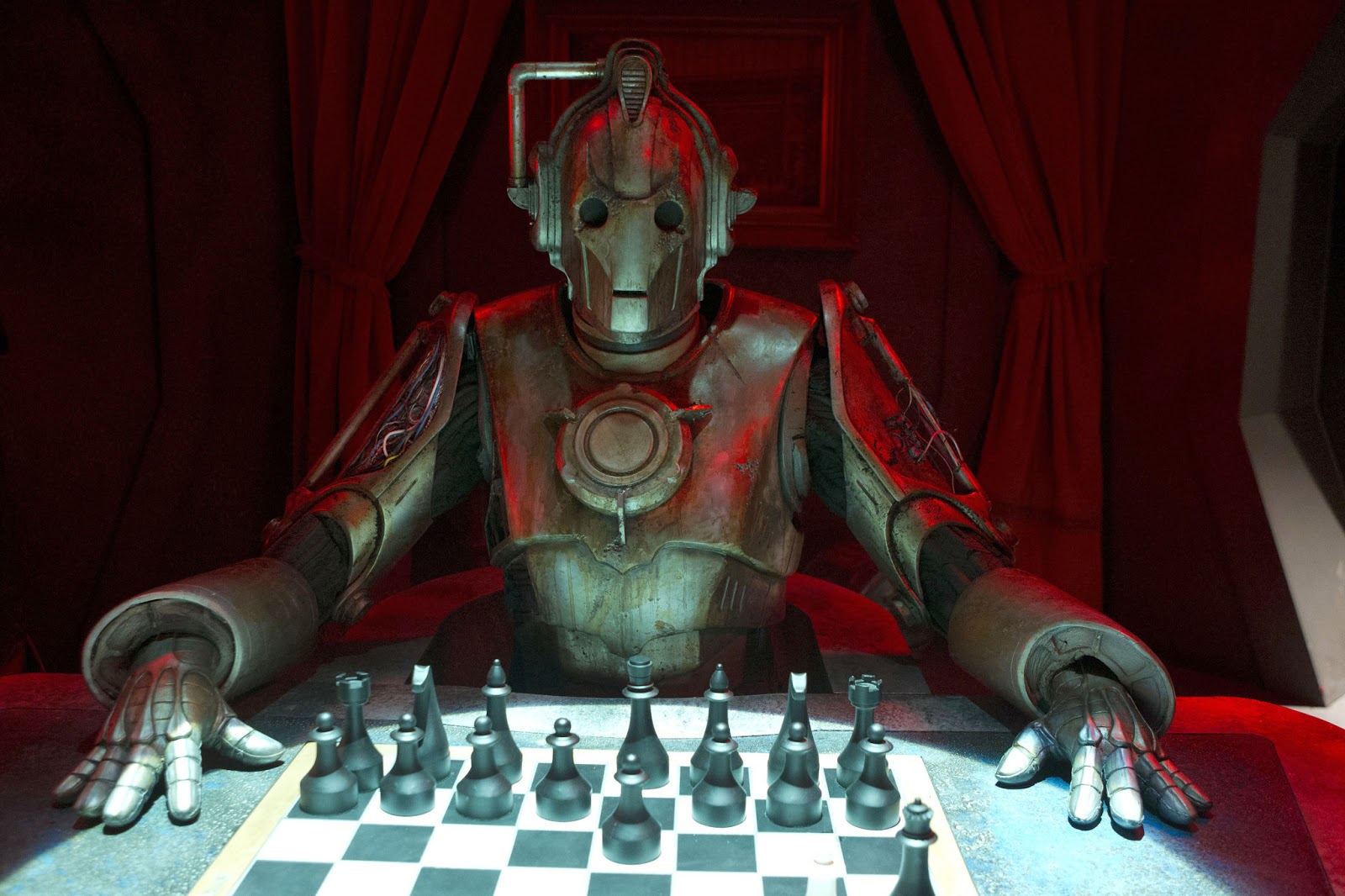
Bafflegab! Everyone loves it. You can’t say the same for Nightmare in Silver. According to a poll that I’ve just conducted in my head, the recent remoulding of the Cybermen comes out slightly higher than The Rings of Akhaten in the category of ‘Favourite Story’. The contentious bones in Neil Cross’ second script are very similar to the ones scattered through Neil Gaiman’s, so we’ll have a look at that one and let Murray Gold breathe a sigh of relief. For now.
Neil Gaiman is probably the most important writer to be involved with Doctor Who since Douglas Adams was script editing it. The Doctor’s Wife, Gaiman’s first script, won the Ray Bradbury Award for Outstanding Dramatic Presentation in 2011 and the Hugo Award for Best Dramatic Presentation the following year. This was despite being rewritten many, many times and having to replace the planned monster with something that wasn’t on display in an exhibition at the time; a jealous Ood turned out to be available so they went with that. The story succeeds despite being compromised and is obviously one that Gaiman had been dying to tell since he was very, very small, a condition in writers that usually produces something special.
This almost brings us to Nightmare in Silver, but not quite.
Every Doctor Who script acts as a skeleton but the producer and director decide what the beast actually looks like. Sometimes the bones join so perfectly they leave only a little room for misinterpretation: Midnight is a good example of a script that’s been structured like this. Another snag is that writing is solitary, whereas making a television programme is collaborative. There’s many a slip twixt pen and DVD rip to coin a phrase. ‘Classic’ Doctor Who is full of these peaks and troughs; every story is an unbalanced yin-yang of success and schadenfreude. With so many individual departments involved, this can’t really be avoided. Don’t forget that no-one ever set out to make a bad Doctor Who, although The Curse of Fatal Death skates very close, and the Borad’s makeup is outstanding.
Obviously there are other matters to take into consideration; Morgus’ fourth wall-shattering asides in The Caves of Androzani came from a misunderstanding between John Normington and director Graham Harper. You take a voluntary step onto dangerous ground when suggesting a Doctor Who story has been unsuccessful; the quicksand is made of well-hidden subjectivity and, although it looks solid, has claimed many well-meaning observations during the last half-century.
The difference between dialogue disaster and triumph can often be down to line-delivery and the hit-rate can further be affected by whether or not the actor’s comfortable with, or even understands, what they’re saying. The word ‘truth’ gets tossed around by thespians like a Cyberhead at a Raston Warrior Robot staff outing, but if we ignore the ‘fact’ that ‘truth’ is merely a matter of perception then we might actually be onto something here. Of course, any actor is going to find extracting something approaching ‘truth’ a challenging proposal when confronted with a line like, “The backblast backlash’ll bounce back and destroy everything.” This is traditionally the point to mention Pip and Jane Baker but, in fairness, they wanted viewers to look up the difficult words and so were at least paving the way with good intentions. Let’s “prevent the catharsis of spurious morality” lest we find ourselves “involved in a web of mayhem and intrigue.”
All of which bring us to Neil Gaiman’s ‘difficult second album’, Nightmare in Silver.
Nightmare in Silver’s definitely a failure, there’s no escaping that, but it’s possible that the blame doesn’t entirely lie with the script – despite its flaws - as much as first appears. There’s some abysmal miscasting throughout for one thing. Facts are thinner than opinions, but the script definitely started life with the title ‘The Last Cyberman’ because a copy was discovered, like many other wonderful things, on the backseat of a Cardiff taxi. However, we don’t know how many rewrites it went through, or at what point in the redrafting Angie and Artie became compulsory components. Gaiman was given the brief to ‘make the Cybermen scary again’, which shouldn’t have been too much of a challenge going on previous work like Sandman. Later, in an interview with the BBC, Gaiman admitted that he became “completely side-tracked by a mad, strange romp.”
Doctor Who has a reputation for being a notoriously punishing show to work on and on, top of that, Nightmare in Silver was hugely anticipated from the outset. Stephen Woolfenden was allocated this story as his Doctor Who directorial debut. Woolfenden began his television career doing second unit work; one of his early jobs included Neverwhere. Having gained an awful lot of experience, he moved into cinema, working as assistant director on David Yates’ Harry Potter films. Despite this, Nightmare in Silver doesn’t seem to know what it is. The tone fluctuates constantly but it’s hard to pin down exactly why and it’s too late to ask Dave McKean to stage a remount. Matt Smith certainly gives the discordant ‘Mr Clever’ moments his all but he’s on a hiding to nothing, for reasons we should definitely bring up.
Both Russell T. Davies and Steven Moffat started their respective runs triumphantly. Davies had planned his first album very carefully, releasing it gradually over three years, like a treble-vinyl prog-monster covered in Hipgnosis. This meant he was able to suggest the Toclafane as a replacement monster for Rob Shearman’s Dalek when the rights to everyone’s favourite Mark III travel machines seemed to be an issue. Toward the end of Davies’ run, the destruction of everything ever had become too small and a type of armageddon fatigue set in, so he dialled everything right back for the seemingly never-ending end of The End of Time: Part Deux, turning the lights off one by one before leaving the stage. In contrast, Steven Moffat was already producing legendary prophecies nobody’d ever heard of by his second series. This was the point when plot-hole-filling prologues popped up and characters began telling the audience stuff, rather than showing them, in a form of bafflegab that no matter how hastily composed, certainly looks good when drying on freshly-printed, individually-named, script sheets. That isn’t to say that the showrunner doesn’t know where he’s going – the whole Moffat era is almost certainly laid out somewhere with all of the important landmarks highlighted in blue. After all, Nightmare in Silver reintroduced the Cybermen in a way that would have alarmed some of the people watching, and that’s what it was intended to do all along.
Neil Gaiman can’t help writing poetic dialogue, Ray Bradbury was the same. Almost everything that ‘Mr Clever’ says would sound utterly chilling in the privacy of a reader’s head and it’s up to the director to make sure that the actor’s delivering difficult dialogue like this in a suitable fashion. Some actors read against the lines or underplay them which can create a unique frisson; not all dialogue needs to be naturalistic to be ‘truthful’. Unfortunately, this is the same half-season that brought us Metebelisgate. Perhaps there’s something distracting glittering in the darkness, who knows?
Recently, Gaiman has made it clear that he really, really wants another chance. He’s publicly stated he’s not worried about money and just wants to be able to spend more time getting the bones of the script in correct alignment. Seeing as he’s probably the most important writer to be involved in Doctor Who since Douglas Adams was script editor, this definitely sounds more like a winning situation than another nightmare. So, we have to ask ourselves, who wouldn’t want that?
Don't forget to visit our forums to discuss this story and many more! A friendly, open and free thinking forum for all Doctor Who fans.Aled Williams, if that is his real name, is short and Welsh. His blog only appears to be about Doctor Who: www.andtheresbloodonit.blogspot.co.uk
All opinion pieces published on this website are the personal opinions of the author and do not represent the views of this website as a whole. Any articles based on rumours will come from a variety of sources and may be true, true in part or completely false, they should not be repeated as fact nor taken as anything other than the rumours they are until there is confirmation from official sources.